Showing posts with label Beauty. Show all posts
Showing posts with label Beauty. Show all posts
Sunday, November 27, 2011
In my beginning is my end
Civilization is in the family, love is in the home, life is in the genes, freedom is in duty. And yet merely to remain at home, to follow your genes, to be obedient to your duty, is merely to dwell, to feel, to reproduce, and to hope. Which of you is satisfied with that? A man finds what he is looking for only after he abandons it. Only he who loses his life will find it, yea, there is not even time to bury your father. In a timeless universe, still, and complete, where nature and end are the same thing, there is no possibility, there is no need of a journey. But bloody Chaos and Old Night have severed phusis from telos. The higher things lie at the end of time, after a sacrifice, after a death. We go to bring back from beyond the grave, from the clutches of Pluto, the beauty that was torn from us, and restore the beauty to the broken form. Yet at the end of journey the beauty turns ghostly, our hands clutch empty air, and we go back to the beginning, an old heart heavy with sadness. But step over the threshold, what do you see? A mother in blue, and a mewling baby. Another hand, stronger than death, has brought back civilization, love, life, freedom, because greater than any of these things, and worthier of desire.

Sunday, August 9, 2009
A Latin Mass
After reading John Senior's Restoration of Christian Culture this morning, where he insists that only communities and persons dedicated to work, prayer, and self-sacrifice will effect the named restoration, and defends his claim through excerpts mostly of the writings of St. Teresa of Avila and St. John of the Cross, I thought it would be fitting to worship this Sunday in the old way. I found a High Latin mass being celebrated in east Arlington. Until they raise enough money for a church of their own, they are borrowing the sanctuary of a Discalced Carmelite nunnery - so that was perfect, since SS. Teresa and John were the male and female reformers of the Carmelites in the 16th century.
The nunnery is off the beaten track, up a small drive on the edge of an old stretch of development along a large road that used to be a major highway into Dallas. It is absolutely serene, almost a paradise in the midst of this humid sparse climate, surrounded like a fortification by perfectly kept, tightly aligned, deepbrown wooden stakes, and guarded by a large gate with an angel perched on each white pillar. The gardens are full of statuary and sweet-smelling trees. The sanctuary is just as carefully and beautifully designed. There is nothing there of industrial life. There are modern materials, but all is put to the service of a true architecture; itself crafted better to serve the cloistered contemplative vocation of the women who spend their lives there.
The priest gave a discursive homily on the Catholic doctrines on indulgences. Some of it very strange, and I wonder whether he described it quite right, because some of it sounded as if it contradicted what little I've read in Aquinas. However, the imaginative background of the doctrines struck me as it had never done before, despite all I've supposedly learned about the body of Christ being one, and each being spiritually tied to each. There is an economy in the body of Christ, where good and evil are shared and felt between one Christian and another, not only in a general, formless sense which only has meaning in devotional rhetoric, but in a concrete sense. The disorder left on the soul by sin, even after repentance and forgiveness, calls out for redress. Scars must be healed. It is possible, according to these doctrines, that God has granted that the good work of one is effective to heal not only his own scars, but the scars of another, and that the recipient of such love is himself enabled to raise up his own prayers for the first. In the midst of this economy, the pope is able to open the storehouses of Christ's grace at his discretion, to the end that certain souls are blessed, and also that the whole community of the church is spurred to greater devotion. The church, in this light, is a spiritual princedom.
What most lifted my spirit, apart from the beautiful voices of the male choir and the people all singing the latin prayers, was the LIFE. Half the communicants must have been under the age of twenty-five, and hardly a missal in sight, they all knew the ancient words. Such life has many taproots, one of which is a sound theology of the family, a subject perhaps fitting for a future post....
The nunnery is off the beaten track, up a small drive on the edge of an old stretch of development along a large road that used to be a major highway into Dallas. It is absolutely serene, almost a paradise in the midst of this humid sparse climate, surrounded like a fortification by perfectly kept, tightly aligned, deepbrown wooden stakes, and guarded by a large gate with an angel perched on each white pillar. The gardens are full of statuary and sweet-smelling trees. The sanctuary is just as carefully and beautifully designed. There is nothing there of industrial life. There are modern materials, but all is put to the service of a true architecture; itself crafted better to serve the cloistered contemplative vocation of the women who spend their lives there.
The priest gave a discursive homily on the Catholic doctrines on indulgences. Some of it very strange, and I wonder whether he described it quite right, because some of it sounded as if it contradicted what little I've read in Aquinas. However, the imaginative background of the doctrines struck me as it had never done before, despite all I've supposedly learned about the body of Christ being one, and each being spiritually tied to each. There is an economy in the body of Christ, where good and evil are shared and felt between one Christian and another, not only in a general, formless sense which only has meaning in devotional rhetoric, but in a concrete sense. The disorder left on the soul by sin, even after repentance and forgiveness, calls out for redress. Scars must be healed. It is possible, according to these doctrines, that God has granted that the good work of one is effective to heal not only his own scars, but the scars of another, and that the recipient of such love is himself enabled to raise up his own prayers for the first. In the midst of this economy, the pope is able to open the storehouses of Christ's grace at his discretion, to the end that certain souls are blessed, and also that the whole community of the church is spurred to greater devotion. The church, in this light, is a spiritual princedom.
What most lifted my spirit, apart from the beautiful voices of the male choir and the people all singing the latin prayers, was the LIFE. Half the communicants must have been under the age of twenty-five, and hardly a missal in sight, they all knew the ancient words. Such life has many taproots, one of which is a sound theology of the family, a subject perhaps fitting for a future post....
Saturday, August 8, 2009
Daughters of Jerusalem, weep not for me, but weep for yourselves, and for your children
Our unlikeness from our ancestors calcifies yearly, as the egg-shell hardens in the womb of the bird. The grandeur of Europe is dead, in its place is a cynical establishment that celebrates a culture of the kitsch, the unmanly, the unfeminine, an abstractive, self-reflexive, self-parodic serpent, which will devour the world before it devours itself. Those uninitiated in this new Dionysian cultural cannibalism live in the entrails of the beast, grasping for dollars with which to buy unearned and dishonorable pleasure and power. In the periodic sufferings of the economic cycle, these acolytes are allowed to despair, perhaps commit suicide, shat into the void, thereby revealing themselves to be weak, and therefore unworthy of the secret knowledge, which is that the world is a Joke without a mouth or a face, that in reality (what is reality?) it is Nothing.
Who among us can walk through the halls of Blenheim, follow the silken melodies of Vaughan Williams, feel the intellectual passion of Rodin, pray in the pews of Notre Dame, ascend the steps to the halls of Congress, study the prudence of Madison, or, closer to our own day, read the grave optimism of T.H. White, and grieve at all for what is gone? We have not the power to feel, for we are cut off from attachment by a horrible bank of garbage, moral, theological, aesthetic. We may ascend the heights of our own side, and view what remains of Western culture with a pleasant detachment, but we lack a sense of belonging.
I believe this is extremely dangerous. At this time we lack a traditional high culture. The whim may arise at any time in our cultural leadership to destroy what relics remain of the old. At those times, and until we regain a confident aesthetic based in a Christian faith, we will have no defense other than our grief to protect these things. Architecture and landscape are clearly the most obvious victims, for they require upkeep and they use valuable land, which is always in demand in this world. But the other high arts are just as much in danger, though for a more subtle, more basic cause. Critical knowledge is easily lost. Taste and judgment and appropriate enjoyment of the good, the true, and the beautiful are not developed by accident, but by purposeful education. The aim to develop such appreciation has largely disappeared from the modern university. If it disappears utterly, then Beethoven and de Tocqueville will be just as invisible as a bulldozed St. Paul's.
Daughters of Jerusalem, weep not for me, but weep for yourselves, and for your children. We must carry on grieving. Teach yourselves, find teachers, to cultivate your taste for Western culture. Steep yourself in it, make the painful sacrifice of emotion necessary to take your place as PART of it. Remember your home with longing and love, so that when they come to destroy it utterly, you may tuck a memory of it away with you. Preserve it in your personal library, share it with your children. Information in books is not enough. You must learn it by heart, and cherish it as your own. Some day the modern world may forget its hatred of the past, and the children of our descendants will be allowed to play in the ruins of the old world. The monastic orders may again become significant. Even then the learning must be preserved. When the renaissance finally comes (and who knows how long that will be?), this knowledge will be valuable, and the grain of wheat that fell to the ground and died will bear much fruit. This is your responsibility to your inheritance, thrown as it has been to the four winds. Gather what you can, add to it if you will from your own soul, and wait for a better day.

Piero di Cosimo - Perseus Frees Andromeda (1513)
Who among us can walk through the halls of Blenheim, follow the silken melodies of Vaughan Williams, feel the intellectual passion of Rodin, pray in the pews of Notre Dame, ascend the steps to the halls of Congress, study the prudence of Madison, or, closer to our own day, read the grave optimism of T.H. White, and grieve at all for what is gone? We have not the power to feel, for we are cut off from attachment by a horrible bank of garbage, moral, theological, aesthetic. We may ascend the heights of our own side, and view what remains of Western culture with a pleasant detachment, but we lack a sense of belonging.
I believe this is extremely dangerous. At this time we lack a traditional high culture. The whim may arise at any time in our cultural leadership to destroy what relics remain of the old. At those times, and until we regain a confident aesthetic based in a Christian faith, we will have no defense other than our grief to protect these things. Architecture and landscape are clearly the most obvious victims, for they require upkeep and they use valuable land, which is always in demand in this world. But the other high arts are just as much in danger, though for a more subtle, more basic cause. Critical knowledge is easily lost. Taste and judgment and appropriate enjoyment of the good, the true, and the beautiful are not developed by accident, but by purposeful education. The aim to develop such appreciation has largely disappeared from the modern university. If it disappears utterly, then Beethoven and de Tocqueville will be just as invisible as a bulldozed St. Paul's.
Daughters of Jerusalem, weep not for me, but weep for yourselves, and for your children. We must carry on grieving. Teach yourselves, find teachers, to cultivate your taste for Western culture. Steep yourself in it, make the painful sacrifice of emotion necessary to take your place as PART of it. Remember your home with longing and love, so that when they come to destroy it utterly, you may tuck a memory of it away with you. Preserve it in your personal library, share it with your children. Information in books is not enough. You must learn it by heart, and cherish it as your own. Some day the modern world may forget its hatred of the past, and the children of our descendants will be allowed to play in the ruins of the old world. The monastic orders may again become significant. Even then the learning must be preserved. When the renaissance finally comes (and who knows how long that will be?), this knowledge will be valuable, and the grain of wheat that fell to the ground and died will bear much fruit. This is your responsibility to your inheritance, thrown as it has been to the four winds. Gather what you can, add to it if you will from your own soul, and wait for a better day.

Piero di Cosimo - Perseus Frees Andromeda (1513)
Friday, February 20, 2009
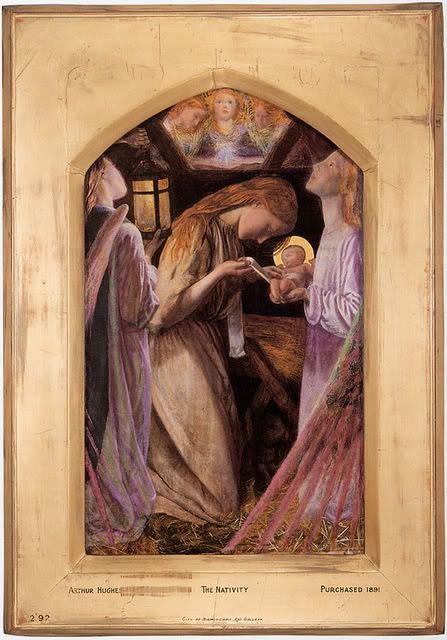
Arthur Hughes
Quite by accident, I stumbled yesterday across a painter who immediately won my admiration. You will, of course, recognize his school:

Ah yes, the pre-Raphaelites, famous for their heady symbolism, their hyper-realism, their wives and the mistresses they raised from poverty, their Edenic reds and golds, large chins (not Edenic), and a faerie medievalism. Yet this man, Arthur Hughes, does not appear in the typical list of pre-Raphaelites. He was one of the outside converts to the cause of Rosseti, Holman Hunt, Millais and the brotherhood, eventually becoming friends with many of them, helping them paint the Oxford Union Debating Hall in 1857. Though he acquired patrons and friends in the 50s, he made his career later, being a popular illustrator for Tennyson, George MacDonald, Christina Rossetti, and Thomas Hughes' Tom Brown's School Days (a marvellous yarn).
You should look for his works online, they are plentiful. I only bring him to your attention for four reasons which cause him to stand out from his contemporaries. First, he paints just enough outline and contrast to cause the people and objects in his paintings stand out in all their individuated glory (as Holman Hunt in particular likes to do), while yet blending into the whole as if they were naturally situate, not contrived. I'm no art critic, but I think it may be because he uses a limited palate, so that all the objects in the painting are similar enough in tone and colour that they come to resemble one another. Second, I love his electric greens and purples. Third better than any the pre-Raphaelites I know, he recreates that quaint, cultivated, but slightly wild light which is the glory of the English summer (though only John Constable has made a truly compendious study of it). Fourth, he has a great deal of fun with medieval-style tryptiches and panels. In a word, he's more homely than the rest of them.

Ah yes, the pre-Raphaelites, famous for their heady symbolism, their hyper-realism, their wives and the mistresses they raised from poverty, their Edenic reds and golds, large chins (not Edenic), and a faerie medievalism. Yet this man, Arthur Hughes, does not appear in the typical list of pre-Raphaelites. He was one of the outside converts to the cause of Rosseti, Holman Hunt, Millais and the brotherhood, eventually becoming friends with many of them, helping them paint the Oxford Union Debating Hall in 1857. Though he acquired patrons and friends in the 50s, he made his career later, being a popular illustrator for Tennyson, George MacDonald, Christina Rossetti, and Thomas Hughes' Tom Brown's School Days (a marvellous yarn).
You should look for his works online, they are plentiful. I only bring him to your attention for four reasons which cause him to stand out from his contemporaries. First, he paints just enough outline and contrast to cause the people and objects in his paintings stand out in all their individuated glory (as Holman Hunt in particular likes to do), while yet blending into the whole as if they were naturally situate, not contrived. I'm no art critic, but I think it may be because he uses a limited palate, so that all the objects in the painting are similar enough in tone and colour that they come to resemble one another. Second, I love his electric greens and purples. Third better than any the pre-Raphaelites I know, he recreates that quaint, cultivated, but slightly wild light which is the glory of the English summer (though only John Constable has made a truly compendious study of it). Fourth, he has a great deal of fun with medieval-style tryptiches and panels. In a word, he's more homely than the rest of them.
Wednesday, December 17, 2008
Religion, and the Alps
It's the last day of exams, so it might be fitting to take note of Belloc's defiantly (and rashly) placing a statue of the Virgin Mary on his desk while he took his final Oxford undergraduate exam; but it also snowed three inches this morning, I've just finished shoveling it off of the funeral home sidewalks, and it put me in mind of Belloc's meditation on the Alps, which he saw on walking expedition to Rome (which I shall explain in a later post). The passage is rather long; I'm including the first parts because they show off his descriptive and story-telling powers, and the latter for his poetic insight about man. I'm also showing this to clear the cant from the minds of friends of mine who, just from reading his eccentric rhymes, think that Belloc is nothing but a drinking, carousing fool. The last line of this passage, incidentally, tells you much about him. I copied the passage out of The Path to Rome from project Gutenberg.
There, on this upper meadow, where so far I had felt nothing but the ordinary gladness of The Summit, I had a vision.
What was it I saw? If you think I saw this or that, and if you think I am inventing the words, you know nothing of men.
I saw between the branches of the trees in front of me a sight in the sky that made me stop breathing, just as great danger at sea, or great surprise in love, or a great deliverance will make a man stop breathing. I saw something I had known in the West as a boy, something I had never seen so grandly discovered as was this. In between the branches of the trees was a great promise of unexpected lights beyond.
I pushed left and right along that edge of the forest and along the fence that bound it, until I found a place where the pine-trees stopped, leaving a gap, and where on the right, beyond the gap, was a tree whose leaves had failed; there the ground broke away steeply below me, and the beeches fell, one below the other, like a vast cascade, towards the limestone cliffs that dipped down still further, beyond my sight. I looked through this framing hollow and praised God. For there below me, thousands of feet below me, was what seemed an illimitable plain; at the end of that world was an horizon, and the dim bluish sky that overhangs an horizon.
There was brume in it and thickness. One saw the sky beyond the edge of the world getting purer as the vault rose. But right up--a belt in that empyrean--ran peak and field and needle of intense ice, remote, remote from the world. Sky beneath them and sky above them, a steadfast legion, they glittered as though with the armour of the immovable armies of Heaven. Two days' march, three days' march away, they stood up like the walls of Eden. I say it again, they stopped my breath. I had seen them.
So little are we, we men: so much are we immersed in our muddy and immediate interests that we think, by numbers and recitals, to comprehend distance or time, or any of our limiting infinities. Here were these magnificent creatures of God, I mean the Alps, which now for the first time I saw from the height of the Jura; and because they were fifty or sixty miles away, and because they were a mile or two high, they were become something different from us others, and could strike one motionless with the awe of supernatural things. Up there in the sky, to which only clouds belong and birds and the last trembling colours of pure light, they stood fast and hard; not moving as do the things of the sky. They were as distant as the little upper clouds of summer, as fine and tenuous; but in their reflection and in their quality as it were of weapons (like spears and shields of an unknown array) they occupied the sky with a sublime invasion: and the things proper to the sky were forgotten by me in their presence as I gazed.
To what emotion shall I compare this astonishment? So, in first love one finds that this can belong to me.
Their sharp steadfastness and their clean uplifted lines compelled my adoration. Up there, the sky above and below them, part of the sky, but part of us, the great peaks made communion between that homing creeping part of me which loves vineyards and dances and a slow movement among pastures, and that other part which is only properly at home in Heaven. I say that this kind of description is useless, and that it is better to address prayers to such things than to attempt to interpret them for others.
These, the great Alps, seen thus, link one in some way to one's immortality. Nor is it possible to convey, or even to suggest, those few fifty miles, and those few thousand feet; there is something more. Let me put it thus: that from the height of Weissenstein I saw, as it were, my religion. I mean, humility, the fear of death, the terror of height and of distance, the glory of God, the infinite potentiality of reception whence springs that divine thirst of the soul; my aspiration also towards completion, and my confidence in the dual destiny. For I know that we laughers have a gross cousinship with the most high, and it is this contrast and perpetual quarrel which feeds a spring of merriment in the soul of a sane man.
Since I could now see such a wonder and it could work such things in my mind, therefore, some day I should be part of it. That is what I felt.
This it is also which leads some men to climb mountain-tops, but not me, for I am afraid of slipping down.
Saturday, December 13, 2008
The Shape of Things that Are
Though shapely curves always deserve uncritical delight, which was what the last post was for, they're also worth some reflection.
What is a curve? It's the way that a shape holds a relationship with its surroundings. There are two main relationships possible: angles and curves. Curves seem to hold their shape in a gentler fashion. They ease into the atmosphere, whereas angles bite. Also, it's harder to hurt yourself on an curve.
Higher geometry pays homage to the curve by extending the meaning of the word in an analogous sense to describe all loci traced by a moving point, so that a line is defined as a straight curve.
A round shape is the final form matters takes when the beating forces of time and the cosmos eliminate all quirks and leave a final tough kernel, in its best defensive posture, like pebbles, or the last-ditch Roman legionary maneuver, the orbem formate. It's the form the planets, the sun and the other stars take to dance across the galaxy. Rivers wind down to the sea, eyes gaze, and tables turn. Curvature is the normal condition of the natural world.
Ambition creates angular shapes. An angle is a challenge to the forces of the universe to break it. It usually has some purpose the environment doesn't appreciate, though most environments eventually surrender - the plow and the pump turned the marshes of East Anglia into fertile black velvet fields. Angles and lines are generally the work of the hand of men to master nature. After the U.S. suffered from its lack of roads during it combat with western Indians in the War of 1812, it commissioned a survey for a military highway from Detroit to Chicago. The inspector found that by the far cheapest route to improve was the old Sauk Indian trail, which wound its way through southern Michigan, fording all the rivers at the shallowest points, and crossing the marshes at their driest. The Indians did not aim to master, and the commissioner had a middling sort of ambition. The Romans, on the far hand, built bee-line roads across Europe that last till this day.
Curved things wear their beauty by fitting into the pattern of the world; their first fresh wildness tugs the heart, but their true grace comes with cultivation. Angles bear their beauty principally in the mind of their maker, and less often for their appearance than for their suitability to his purpose - in a word, their workmanship; but the beauty of a curve is an end in itself.
So there seems to be a natural resemblance between angles and curves and masculinity and femininity, as many have thought before. Also consider that nothing sharpens the loveliness of a curve so well as a line. But now we reach mystic matters, so it's time to be silent.
There is a third kind of relationship of a shape to its surroundings which I haven't mentioned. That is the fractal. It's a shape whose parts resemble the shape of the whole, repeating down into infinity. The curve resembles it more closely than does the angle, just as there's a good argument to be made that the nature of woman is closer than man's to the mysterious centre of God (see Gene Edward's The Divine Romance). It's impossible to conceive apart from its mathematical equation, for at its revelation the image is infinitely marvelous. It's the tuck of design within design. Perhaps it's the corresponding shape of divinity.

Illustration to Dante's Divine Comedy, Paradiso by Gustave Doré. Plate 34. Dante and Beatrice and the Heavenly Host of Angels (Canto 31: The Saintly Throng in the Form of a Rose)
What is a curve? It's the way that a shape holds a relationship with its surroundings. There are two main relationships possible: angles and curves. Curves seem to hold their shape in a gentler fashion. They ease into the atmosphere, whereas angles bite. Also, it's harder to hurt yourself on an curve.
Higher geometry pays homage to the curve by extending the meaning of the word in an analogous sense to describe all loci traced by a moving point, so that a line is defined as a straight curve.
A round shape is the final form matters takes when the beating forces of time and the cosmos eliminate all quirks and leave a final tough kernel, in its best defensive posture, like pebbles, or the last-ditch Roman legionary maneuver, the orbem formate. It's the form the planets, the sun and the other stars take to dance across the galaxy. Rivers wind down to the sea, eyes gaze, and tables turn. Curvature is the normal condition of the natural world.
Ambition creates angular shapes. An angle is a challenge to the forces of the universe to break it. It usually has some purpose the environment doesn't appreciate, though most environments eventually surrender - the plow and the pump turned the marshes of East Anglia into fertile black velvet fields. Angles and lines are generally the work of the hand of men to master nature. After the U.S. suffered from its lack of roads during it combat with western Indians in the War of 1812, it commissioned a survey for a military highway from Detroit to Chicago. The inspector found that by the far cheapest route to improve was the old Sauk Indian trail, which wound its way through southern Michigan, fording all the rivers at the shallowest points, and crossing the marshes at their driest. The Indians did not aim to master, and the commissioner had a middling sort of ambition. The Romans, on the far hand, built bee-line roads across Europe that last till this day.
Curved things wear their beauty by fitting into the pattern of the world; their first fresh wildness tugs the heart, but their true grace comes with cultivation. Angles bear their beauty principally in the mind of their maker, and less often for their appearance than for their suitability to his purpose - in a word, their workmanship; but the beauty of a curve is an end in itself.
So there seems to be a natural resemblance between angles and curves and masculinity and femininity, as many have thought before. Also consider that nothing sharpens the loveliness of a curve so well as a line. But now we reach mystic matters, so it's time to be silent.
There is a third kind of relationship of a shape to its surroundings which I haven't mentioned. That is the fractal. It's a shape whose parts resemble the shape of the whole, repeating down into infinity. The curve resembles it more closely than does the angle, just as there's a good argument to be made that the nature of woman is closer than man's to the mysterious centre of God (see Gene Edward's The Divine Romance). It's impossible to conceive apart from its mathematical equation, for at its revelation the image is infinitely marvelous. It's the tuck of design within design. Perhaps it's the corresponding shape of divinity.

Illustration to Dante's Divine Comedy, Paradiso by Gustave Doré. Plate 34. Dante and Beatrice and the Heavenly Host of Angels (Canto 31: The Saintly Throng in the Form of a Rose)
Thursday, December 11, 2008
Curves
Beauty: it curves: curves are beauty. Shapely goddesses, Venus, Juno: curves the world admires.
James Joyce - Ulysses

Rock 'n' Roll sur les Quais de Paris
by Paul Almasy

Venus
by Jean Baptiste Pigalle,
Commisioned for Frederick the Great's summer palace, Sanssouci
James Joyce - Ulysses

Rock 'n' Roll sur les Quais de Paris
by Paul Almasy

Venus
by Jean Baptiste Pigalle,
Commisioned for Frederick the Great's summer palace, Sanssouci
Subscribe to:
Posts (Atom)